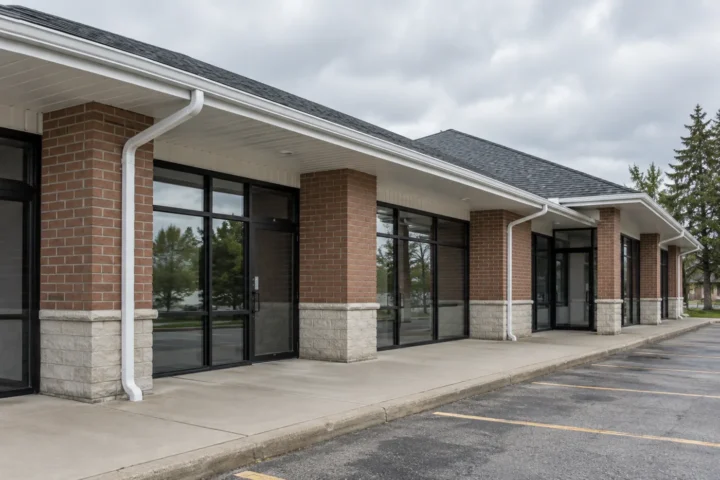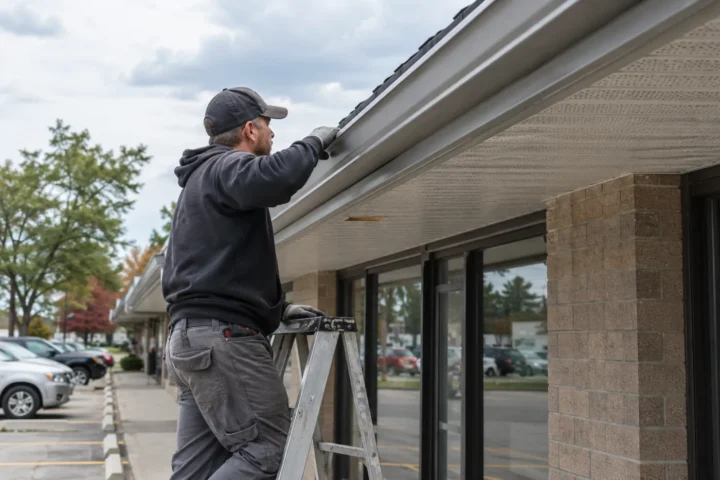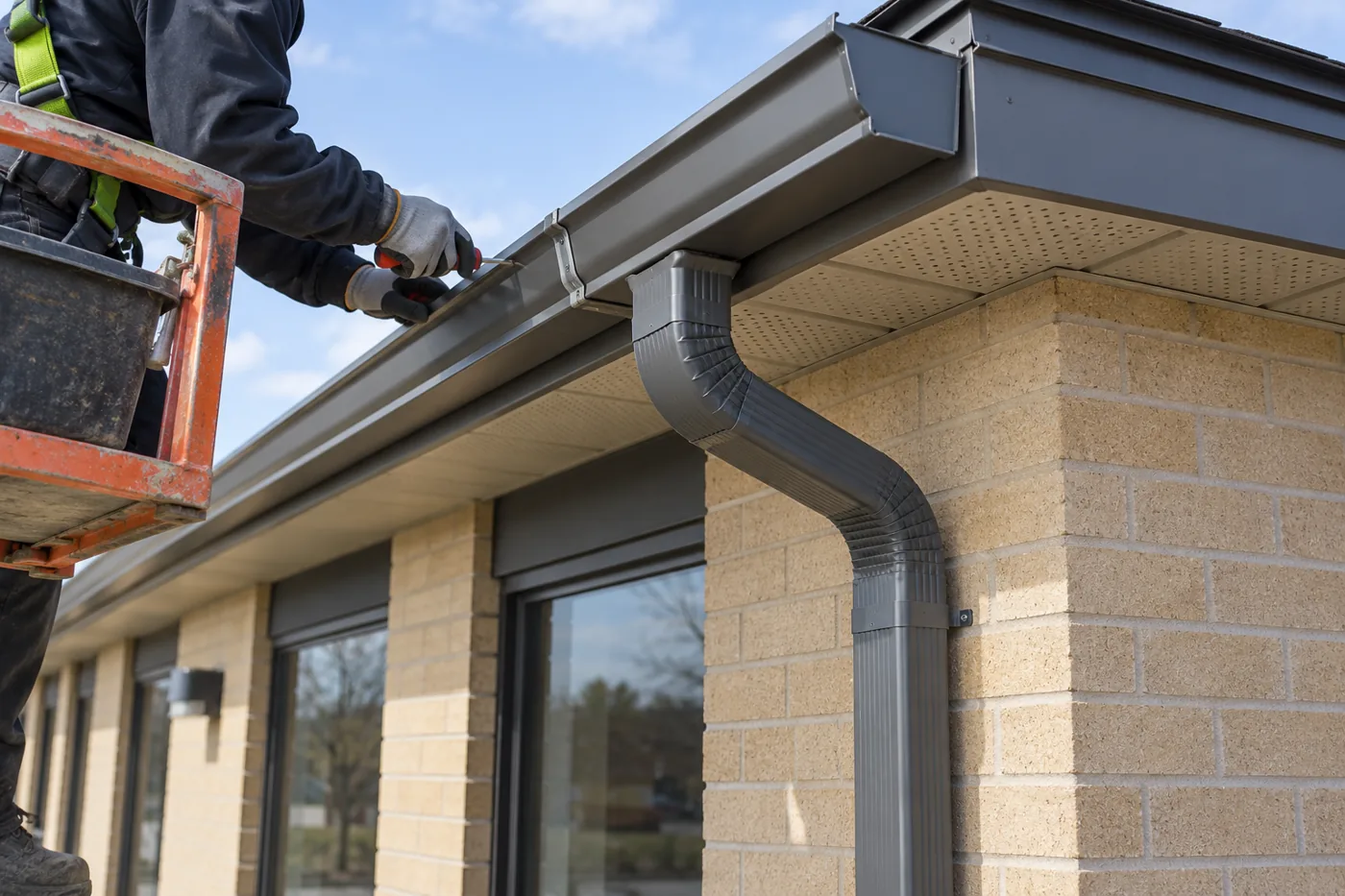
A leaking joint at a storefront and a crushed downspout beside a loading bay call for different repairs. Commercial gutter work begins with identifying the affected elevation, likely cause and condition of adjacent material. Many isolated failures can be addressed without replacing all the exterior gutters on a plaza or multi-building property. Repeated leaks across long runs, weak backing or poor outlet layout may instead justify a broader plan. Access and tenant coordination need to be considered alongside the metalwork.
Locate the failure under the right conditions
Record whether the issue appears in ordinary rain, only under heavy valley flow or after snowmelt. A wet wall under a joint does not prove the connection is the source; water may track from a higher roof edge. Overflow from a restricted outlet can be mistaken for a leak. Photos during a storm, taken safely, make this distinction easier.
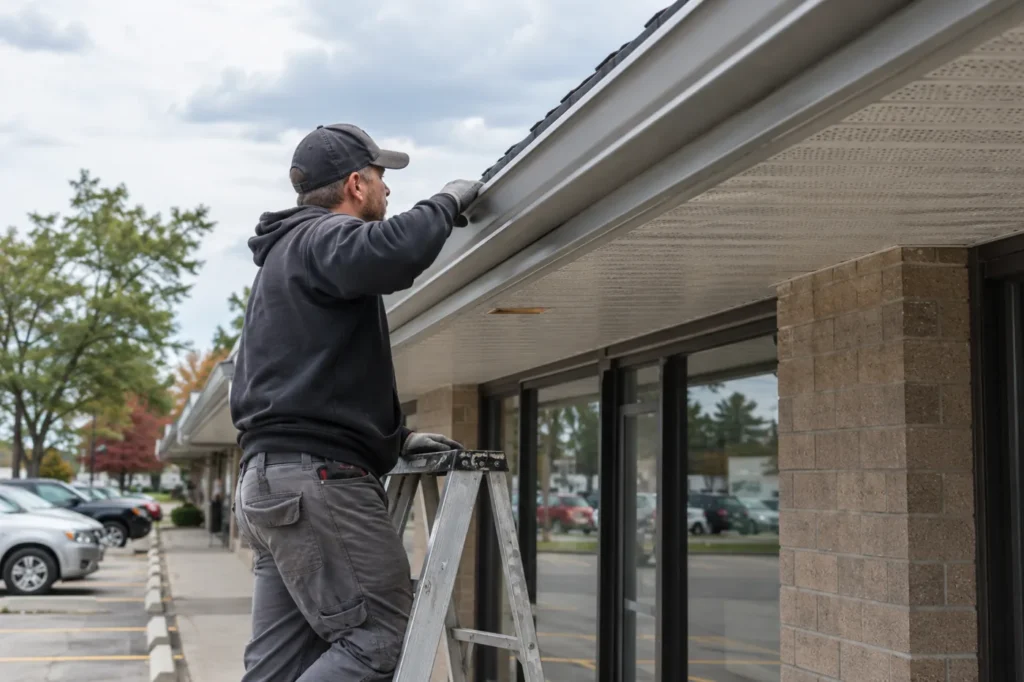
Inspect corners, end caps, seams, hangers, outlets and downspout elbows. On a long run, note whether standing water indicates a sag. An impact-damaged lower pipe may be visibly obvious, while a recurring upper restriction requires a closer path check.
Match the repair to the failure
A local connection, short section or downspout piece may be repaired or replaced when surrounding components remain sound. Hanger work depends on reliable attachment material. Resealing an outlet without clearing a restriction or supporting a moving run may only postpone another leak.
Where multiple joints fail or the channel is deformed across an elevation, compare repeated repairs with partial replacement. A useful recommendation identifies exactly which lengths can stay and which cannot, rather than using one failed corner to justify whole-site replacement.
Account for site use
A repair over an active entrance, parking row or loading door may need controlled access and a schedule coordinated with the property contact. Exterior fixtures, awnings and signage can affect how the area is reached. If several tenants report water, map each report to an elevation rather than assuming one cause.
The downspout discharge area matters after repair. Restoring full flow through a previously leaking section may reveal puddling at a walkway or vehicle route. Those are separate drainage observations that should be documented before a repair is considered complete.
Document the boundary of the work
The scope should name the failed component, adjacent condition, planned access and whether cleaning or outlet work is included. Existing roof membrane, internal drains and wall leaks outside the gutter route are separate questions. The repair should not be presented as a guarantee against all moisture entering the building.
After work, check support and alignment as well as the repaired connection. Track any later leak against the original location and rainfall conditions. A recurrence elsewhere may reflect another component rather than failure of the first repair.
Prioritize active water and access
Water spilling onto an entrance or tenant walkway has a different consequence from a small drip over a landscaped rear edge. A site contact can identify doors and operating hours affected by the work. The repair still needs diagnosis, but location helps decide how to plan safe access and what information to collect first.
If there are several reports, give each a building and elevation reference. One heavy-rain complaint near a loading area may not share a cause with a leak over an office window. Grouping them as one generic repair can miss both the source and the access requirements.
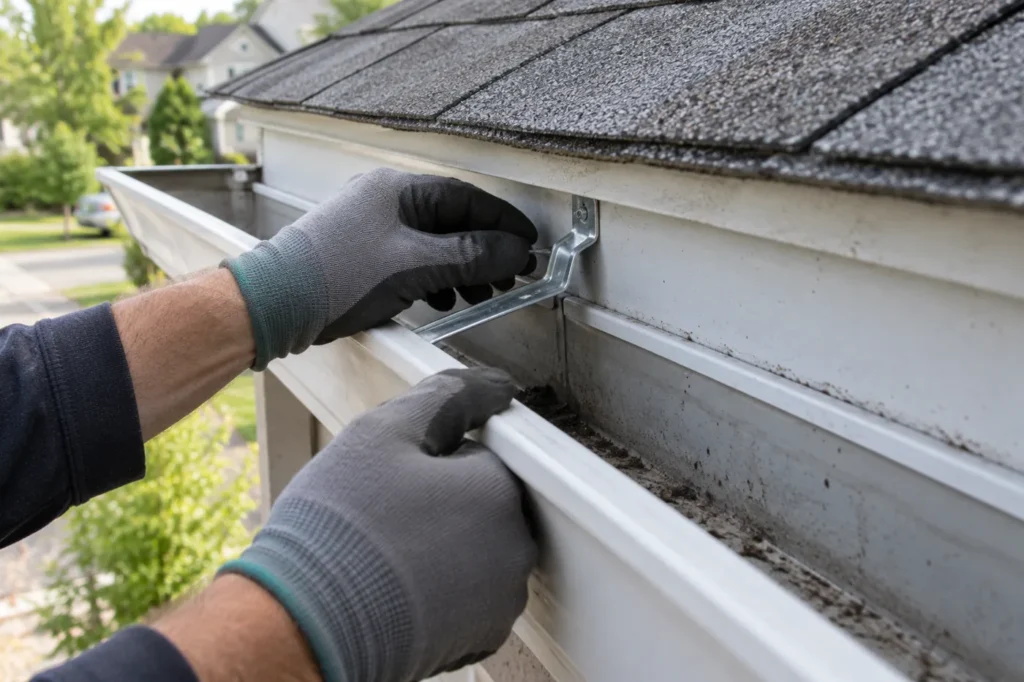
Check the support under a loose section
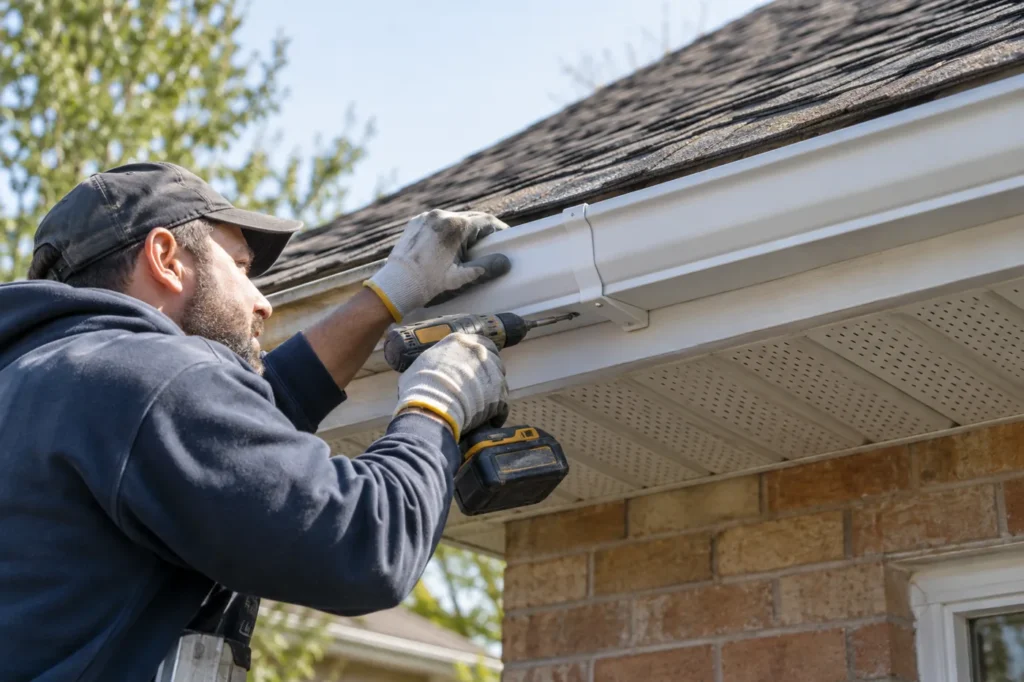
A loose commercial run may be affected by fasteners, hanger spacing, accumulated debris or the surface into which it is attached. Refitting to unsound backing can fail again. The repair should identify whether a short length can be supported properly or whether adjacent fascia and substrate need separate attention.
On a long run, one sag can hold water against a corner and accelerate leakage. Sealing the corner without correcting the low point may not be durable. Conversely, a single impact-damaged piece can sometimes be isolated when the rest of the layout works.
Define repair acceptance by the symptom
For a joint leak, inspect the connection and adjacent alignment after work. For a backed-up outlet, verify the path through the downspout. For a loose section, confirm suitable support. The completion check should correspond to the diagnosed failure rather than relying on a generic visual statement.
Some conditions only show under substantial rainfall. Record what was observed before and after, and distinguish a remaining roof or wall issue from the repaired gutter component. This avoids giving an owner a false impression that every moisture path was addressed.
Restore flow without creating an entrance hazard
Follow roof runoff through the suspect gutter run, outlet, downspout and discharge. Commercial entrances and loading zones heighten the importance of where restored flow ends. Repairing one seam while a downspout empties over a doorway addresses only one part of the route.
Scope and cost factors
Cost depends on height, access, length and condition of affected metal, extent of joint or substrate work, tenant coordination and any equipment requirements. Ask whether the quote treats a single component, one elevation or multiple buildings; those scopes are not interchangeable.
Details to include in your request
Send safe photos or video of the leak during rainfall, then dry close-ups, elevation and building location, and access restrictions. Note prior repairs and whether nearby downspouts flow freely. For multi-tenant properties, collect the dates and locations of separate reports.
Read repeated failures as a pattern
A joint resealed several times on one elevation may be moving because of loose attachment, water retained by poor slope or a restricted outlet. A fresh drip is then evidence to examine the supporting condition and flow, not an instruction to repeat the same sealant treatment. Ask for dates and locations of earlier repairs if available. Compare whether those repairs failed at the same corner or whether different parts of a run have begun to leak. That history helps distinguish an isolated connection from a declining length of gutter.
Separate metal damage from connection failure
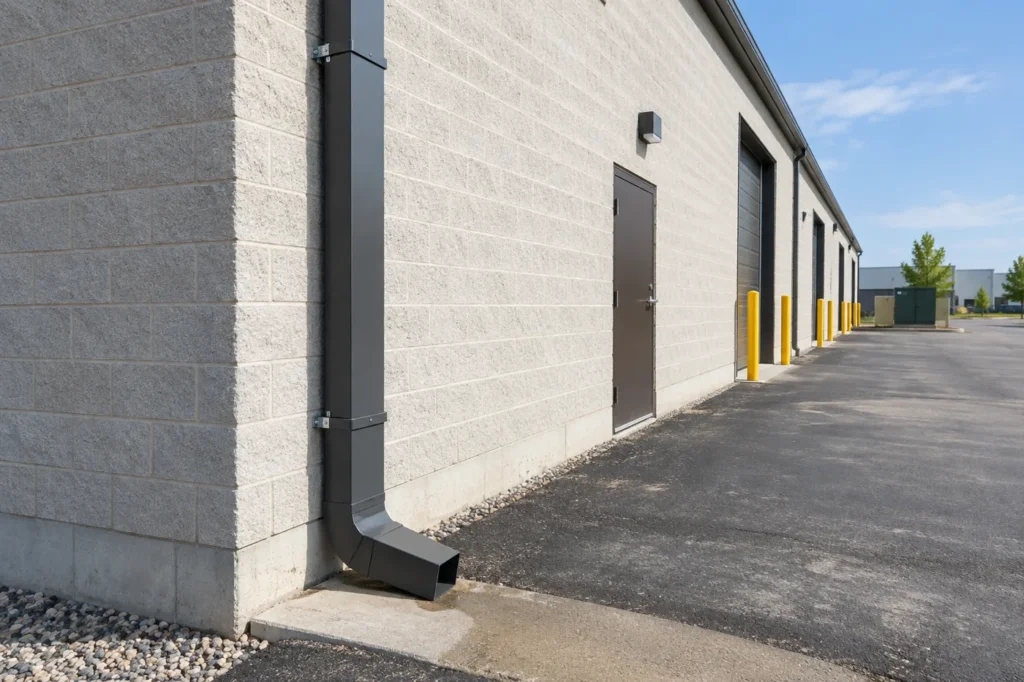
Impact from a vehicle or maintenance activity can crease a lower downspout or deform a gutter near a loading bay. A seal at the resulting joint will not restore the metal shape or support. Conversely, a sound run with a small opening at an end cap may not need broad replacement. The inspection should identify the damaged part, adjoining profile and compatible replacement material. For a pipe exposed to repeated impact, consider whether its route or protection needs review instead of repeatedly fitting the same vulnerable section.
Trace a reported wall leak carefully
A tenant may notice a wet wall or ceiling during rain and associate it with the nearest exterior gutter. The water could come from an overflowing channel, a connection, a roof-edge detail or another building-envelope path. Record when the wetness begins relative to rainfall and where outside water first becomes visible. Gutter repair should be specified only for a gutter defect that can be identified. Roof membranes, internal drains or wall assemblies require separate investigation when indicated; exterior metal work should not be presented as a remedy for those systems.
Choose the smallest dependable scope
A local hanger, outlet, end cap or short run may be repairable if adjacent metal drains correctly and is secured to sound material. A run with several open joints, recurring sag or widespread distortion may be better addressed as one replacement length. The decision can be expressed by building and elevation, keeping sound sections outside the work. The quote should also state whether outlet clearing, fascia preparation and downspout work are included; these are often the details that determine whether a local repair remains dependable.
Define a useful follow-up observation
Match the review to the original complaint. A leaking joint should be checked for renewed dripping; a loose run for secure attachment while loaded; an overflow for movement of water through the outlet and final discharge. One dry inspection cannot fully reproduce an intense storm, so retain the original location and weather context. If water continues after a gutter defect has been corrected, assess the remaining path rather than assuming the same metal connection has failed again.
Continue planning the right work
If repeated joints fail across an elevation, compare a local fix against replacement planning rather than resealing indefinitely. A damaged or badly routed pipe belongs in the downspout assessment. Recurring debris and outlet restrictions can be considered under cleaning and maintenance, where an elevation-specific condition record can help distinguish a genuine repeat failure from an unrelated new location.