Build a schedule from the property, not a calendar slogan
There is no single cleaning interval that suits every Milton roofline. A home beneath mature trees may collect seeds in spring and leaves in autumn. Another property with few trees may still receive roofing grit and debris at a valley. Guarded gutters can collect material on top or at the outlet. Number of storeys and safe access also affect how inspection is performed. Begin with the property's past clogging and overflow history, then adjust after observing a full seasonal cycle.
For each elevation, identify the roof planes, valleys, gutter runs, outlets, downspouts and final ground endpoints. A simple sketch or a set of labelled photos helps explain where problems recur. Avoid climbing in wet, windy or icy conditions; observations from the ground and professional inspection are better than an unsafe close-up.
Spring: seeds, blossoms and winter damage
As snow and ice clear, look for sections displaced by winter conditions, loose downspout straps, separated elbows and extensions moved by shovelling or plows. Spring seeds and blossoms can form dense mats at outlets even before broad leaves appear. Check whether meltwater left staining on fascia, soil displacement at discharge or ice-related damage around an entrance.
Spring is also a useful time to compare what the gutter does during an ordinary rain against its winter appearance. A stain alone does not prove an active leak. Note whether a joint drips, water overtops the front edge or runoff emerges from behind the channel. Gutter repair and cleaning address different findings; a clear symptom record helps choose correctly.
Summer: watch concentrated storms
Heavy showers can reveal flow issues that do not appear in light rain. From a safe indoor or ground-level vantage, observe the first point where water escapes. Does a roof valley overshoot? Does an outlet submerge while the downspout struggles? Does water reach the gutter but spill from a low section? Is the channel clear, yet the extension sends water across a walkway? These observations are valuable for overflow troubleshooting.
Do not enter a storm to test a downspout manually. Record the location and approximate timing, then check the property afterward for displaced soil, standing water or debris near the endpoint. A downspout that appears attached at the roofline can separate at an elbow or below a strap. If water is seen indoors, seek a broader basement-water assessment rather than assuming the gutter explains every entry path.
Autumn: leaves and outlet restrictions
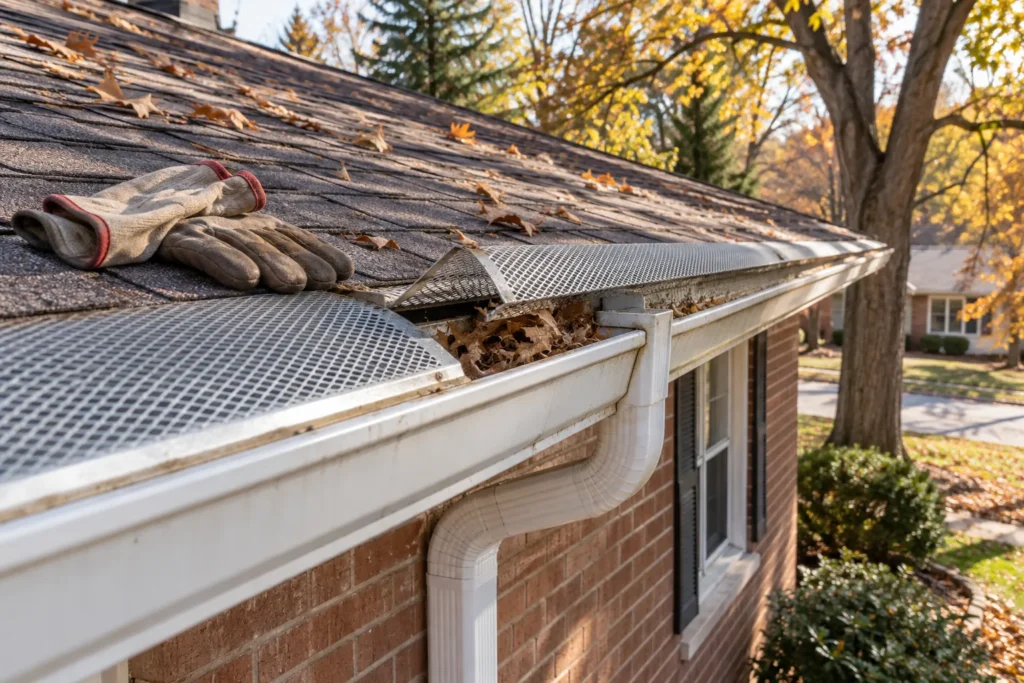
Leaf fall can arrive in several waves rather than one event. A single large tree can affect one run much more than the rest of the house. Look for leaves caught at valleys, corners and guard surfaces, not just material visible inside the channel. An outlet may restrict flow while the rest of the gutter looks reasonably clear. The downspout can also hold compacted debris in an elbow.
Choose a cleaning window based on actual leaf fall and expected weather, then confirm that water can leave the outlets. If a gutter guard is installed, ask how its surface and hidden channel will be inspected. Gutter guards may reduce debris entry, but they do not remove autumn inspection. Multiple rounds may be sensible on a heavily treed property; a lightly exposed roofline may need less.


Prepare the discharge route before freezing
At ground level, confirm that extensions remain connected and send water to a suitable area away from the building. A moved extension may end against a foundation wall after summer yard work. A route across an entrance, driveway or path can become a winter ice issue when daytime melt refreezes. Consider where plowed snow will land and whether an extension could be damaged or blocked.
The Milton drainage guide explains the Town's distance recommendation and Halton's ideal guidance. Those distances do not override practical site constraints; the endpoint and grade matter. Altering grading or drainage patterns is a separate municipal question from reconnecting a loose elbow.
Winter: observe without damaging the roofline
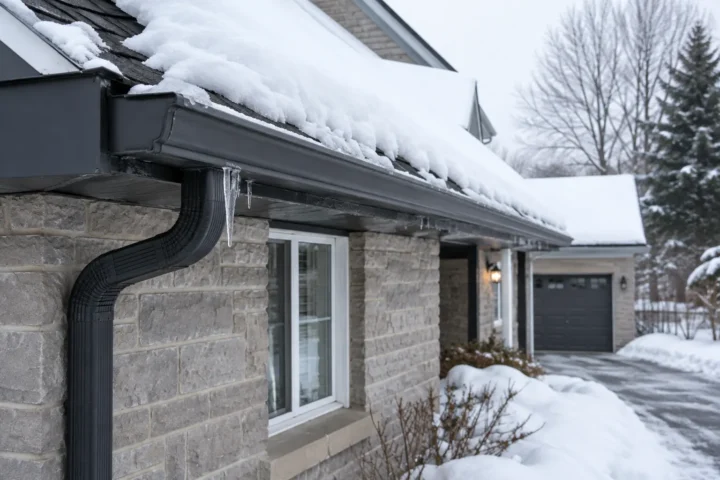
Ice can form in downspouts, at the outlet and at a discharge point. Snow load or a frozen blockage can reveal weak attachments. Icicles may be associated with several conditions, including roof heat and weather, so do not diagnose an ice dam from a photograph of a gutter alone. Use winter gutter guidance to separate safe observations from work that may require a different trade.
Avoid striking ice with tools against aluminum, fascia or roofing. Keep people away from falling ice and slippery entries. Document repeated locations and freeze-thaw timing; this helps determine whether a blocked downspout, poor route, attachment concern or building-envelope condition deserves investigation after conditions are safe.
Inspect the components in a consistent order
From the ground, follow the route from roof edge to final discharge. Check gutter alignment, visible fall, joints, corners, end caps and attachment. Look for debris at valleys and outlets. Follow downspout elbows, vertical runs and straps. Check that water leaves into a suitable area rather than returning toward basement walls or crossing a high-traffic surface. Include nearby soffit and fascia where staining or movement appears.
A professional inspection may be needed for upper-storey or hidden conditions. The aim is to identify cause and scope, not to make every season a replacement project. A sound system may need cleaning; a loose section may need a targeted repair; recurring overflow after cleaning may require redesign of outlet or downspout arrangements.

Different building types call for different records
For a rental home or a managed group of buildings, a dated record of affected elevations, outlets, cleaning and repairs helps identify patterns across seasons. Record what was actually found instead of only saying that a visit occurred. A recurring debris mat at one valley may support targeted inspection there, while repeated leaks across several buildings can inform a broader replacement plan. Do not assume identical buildings have identical tree cover or discharge conditions.
On a single home, a short note after a storm can be enough. Note the direction of rain, first spill position, downspout endpoint and any newly displaced extension. A photograph taken safely from the same position each season makes changes visible. These records help avoid unnecessary whole-house work and make a later assessment more focused.
Remember the garage and lower roof
Small roof sections are easy to omit from a maintenance walk. A garage downspout can empty onto a driveway, while a porch outlet may be hidden behind planting. These areas can create ice at an entrance even when the main house gutters work. Include them on the property sketch and check their endpoints after landscaping or snow removal changes.
Record changes and use them to plan work
Keep a short record with dates of heavy rain, clogs, cleaning, repairs and visible water routes. Photograph the same corners and ground endpoints over time from safe positions. A pattern of repeated clogs under one tree differs from widespread leaks or sagging. This record can guide a maintenance inspection and prevent the same symptom being treated repeatedly without finding its cause.
For an estimate request, share which elevations are affected, what season exposes the issue, whether guards are present and where each downspout ends. The useful question is not “How often should everyone clean?” but “What does this property's debris, roof geometry and runoff history require?”