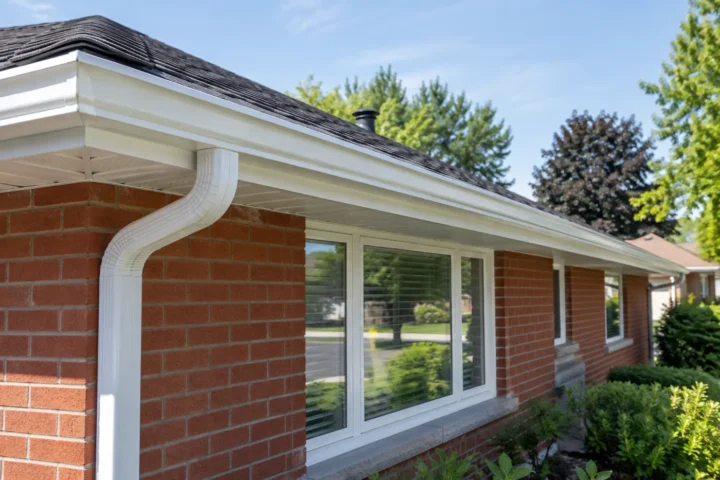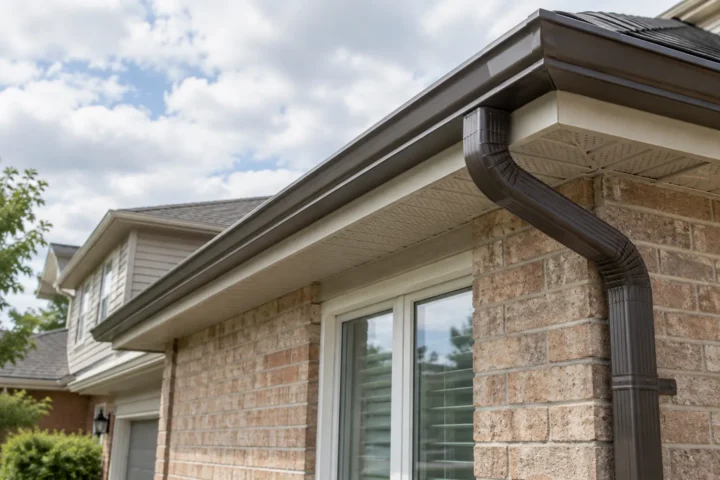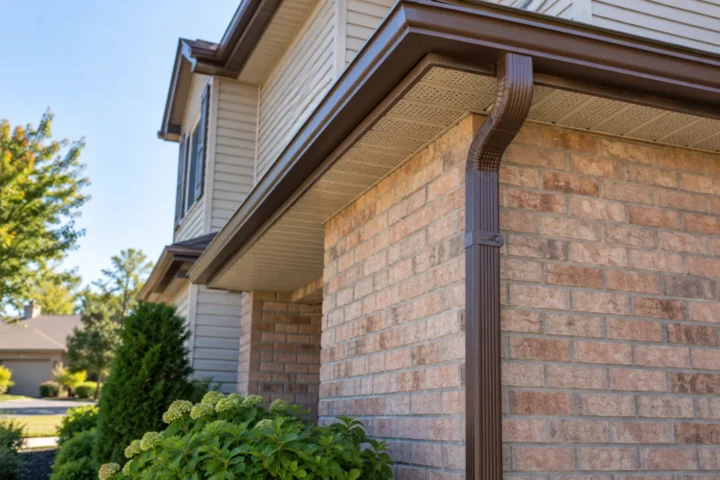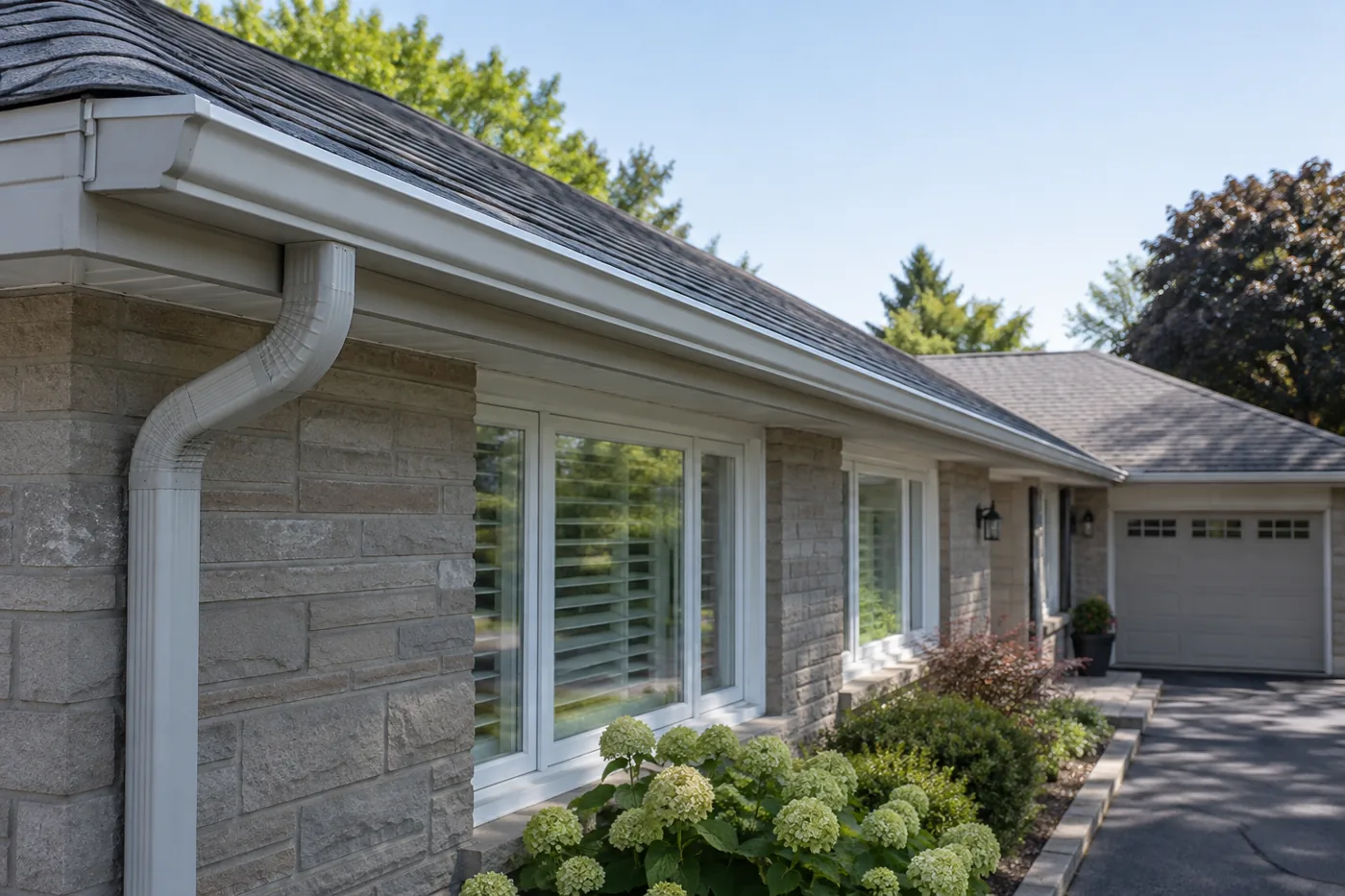
The term seamless describes long gutter sections formed for the measured roofline rather than joined from many short lengths. It does not mean a house has no joints: corners, end caps and outlets still interrupt the run. The advantage is fewer intermediate seam locations and a clean, consistent profile. The suitability of a new seamless run depends on attachment, pitch, roof geometry, downspout design and available discharge locations. Material choice is only one part of the installation decision.
Where continuous runs make sense
Straight eaves can often be served by a long formed piece. A roofline broken by corners, gables, porch connections or additions naturally requires multiple sections and properly detailed transitions. An exceptionally long run should be evaluated for outlet spacing and movement rather than simply made continuous for appearance. The number of seams matters, but so does whether the run drains efficiently.
A seamless replacement can match the current arrangement or change the layout to handle runoff more effectively. Before reproducing an old channel, identify high-flow valleys, sagging, recurring overflow and whether water reaches the correct outlet. A new continuous run with the same restriction or poor slope will not solve the underlying problem.
Profiles, colour and roof-edge fit
Profile selection should fit the architecture and the runoff pattern. A larger profile may help in a properly designed system, yet it is not a universal upgrade. Roof area, pitch, valleys, outlet size and available downspouts form the sizing context. Finish and colour can coordinate with aluminum fascia and soffit, but visual matching should not drive an unsuitable route.
Review fascia and its supporting substrate before fastening. Aluminum wrap can hide deterioration without providing structural strength. If the backing is weak, it needs an appropriate separate repair. A level-looking roofline may itself vary, so the channel must be set for positive drainage without an awkward or misleading visual line.
Connection details still matter
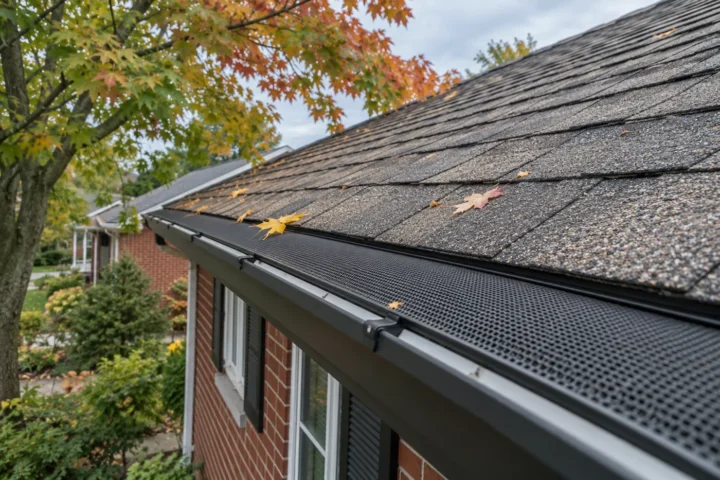
Every corner, end cap and outlet remains a potential point of movement or leakage. These locations need careful fit, support and access for future inspection. A seamless run does not eliminate cleaning, because leaves and roofing grit can still collect at the outlet and debris can bridge a guard.
Downspouts should be sized and routed for the water delivered by the gutters. Where a single outlet receives runoff from a broad roof section, the downspout and final discharge require particular attention. An elegant aluminum line at the fascia is incomplete if water empties beside an entrance or against a basement wall.
Replacement without assumptions
Some projects can retain sound downspouts; others need a new location or length. Verify their condition, straps, elbows and extension before deciding. Existing guards also need compatibility and condition checks rather than automatic reuse. Removal can expose fascia damage or old fastening holes that alter the scope.
In an estimate, distinguish the measured gutter runs from corners, outlets, downspouts, guards, fascia work and disposal. Ask how discharge will be handled and how hidden substrate damage would be assessed. The result should be a coherent roof-water route, not only a price for aluminum by the foot.
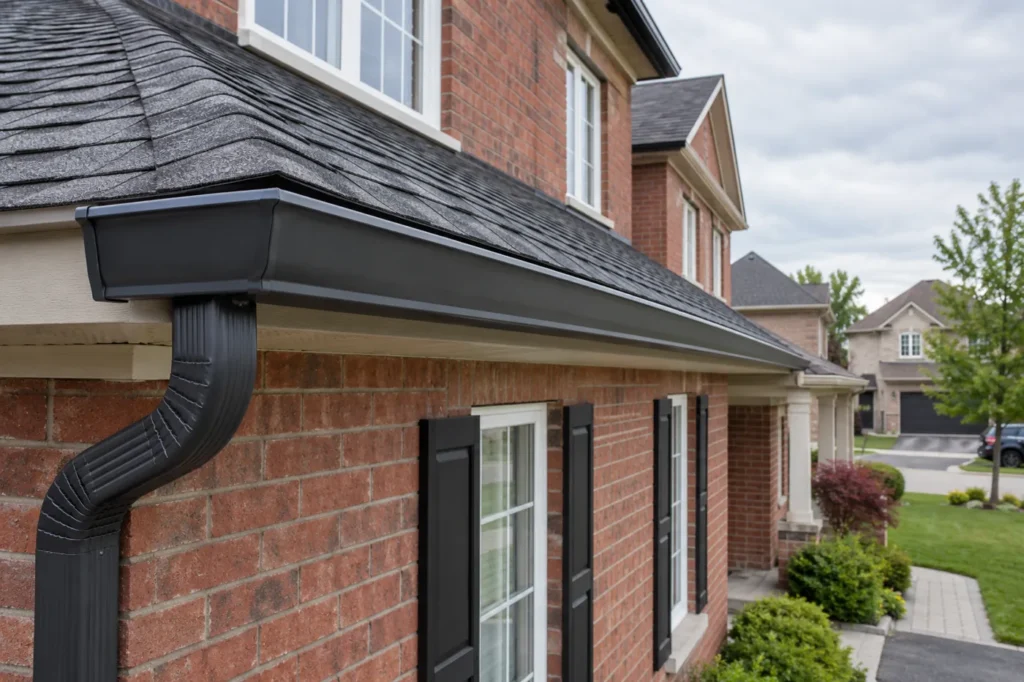
Where fewer joints matter most
On a long straight eave, forming a run to length removes several intermediate seams that would otherwise need joining. On a roofline with frequent corners, the number of unavoidable connections remains relatively high. Compare the actual roof geometry rather than assuming the word seamless has the same practical value at every elevation.
Continuous sections also need to be brought into position safely, supported correctly and pitched to an outlet. A long run that bows or ponds is not improved merely because it has no mid-run seam. Handling and access should be considered where trees, narrow side yards or other obstructions surround the house.
Finishes and future maintenance
Aluminum offers a range of colours, but a match to older fascia or soffit can be affected by fading and product availability. Compare the proposed finish outdoors beside existing materials. Profile proportions can be as noticeable as colour, especially on a front gable or deep roof overhang.
A continuous channel still accumulates organic debris and roofing grit. Plan for access to the outlet, corners and guard surfaces if guards are added. If an individual connection begins leaking years later, it can often be assessed locally without treating the entire length as disposable.
Installation quality over a label
The core decisions remain sound attachment, controlled slope, appropriate outlet placement and a clear path down and away from the building. A field-formed material does not tell you whether the fascia backing is suitable or whether the outlet empties beside a walkway. Ask those questions directly in the estimate.
When an older system failed, note whether the cause was leaking joints, debris, sagging, concentrated valley flow or final discharge. Seamless aluminum can reduce one class of connection detail; the other causes need their own remedies. This distinction prevents a material upgrade from being mistaken for a full drainage redesign.
Installation decisions the term seamless cannot answer
How much roof drains toward one outlet? Are valleys feeding a short stretch? Is the supporting fascia secure? Can a downspout descend without crossing a window or entry? Where does it discharge after the lower elbow? Each answer can matter more than the presence or absence of intermediate seams. A formed run should be designed around them rather than added as an isolated product.
A long channel can be visually clean but may need more than one outlet or a carefully controlled slope. Extra corners and offsets increase the number of connection details regardless of material. On an unusually complex roofline, the simple comparison of “seamless versus sectional” does not describe the real installation difficulty.
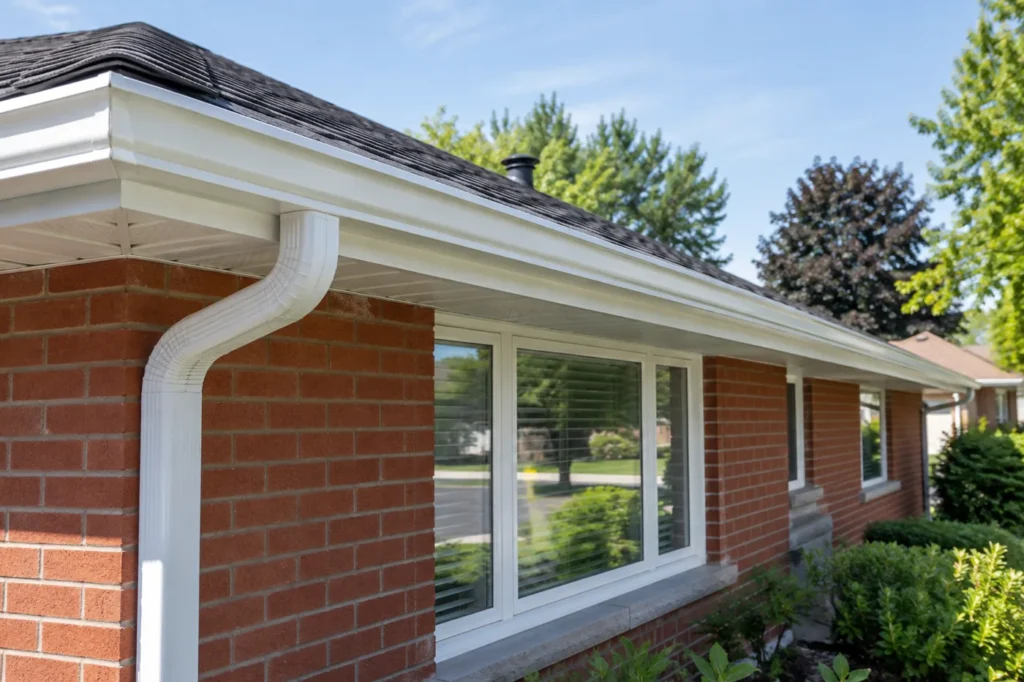

Consider existing components individually
A downspout may be reusable if it is intact, properly supported, compatible with the outlet and sensibly discharged. An existing guard might fit a new profile or might conceal persistent debris. Fascia can look sound from the street while old fasteners have lost their grip. Inspect each rather than automatically replacing or retaining it as a bundle.
If old gutters are removed, the newly exposed roof edge can reveal water damage. Discuss how additional backing work would be evaluated. New aluminum should not be fastened into a weak substrate to preserve an initial price or covered with fascia metal that hides the issue.
What long-term care still involves
Look at corners and outlets periodically for separation, debris and standing water. A continuous run can still be struck by a branch, move at an attachment or collect grit below a guard. The maintenance pattern depends on trees and roof shape, not whether the run was formed on site. Keep the final downspout extension in position so the roof-water system ends where planned.
If a leak later occurs, describe its location precisely. A connection point may be repaired locally; a deformed length or failed backing may call for a broader discussion. The material name alone cannot determine the repair scope.
What seamless does not specify
The finished result still depends on the gutter’s attachment and pitch, not merely its manufacture. For example, an uninterrupted run can hold a pool if its low point falls between outlets. Conversely, a short run with an appropriate outlet and sound corner may drain well even though it has a connection. Compare the actual runoff behaviour and the proposed route. A request for “seamless” should prompt a conversation about corners, downspouts, fascia backing and discharge, not end it. This matters especially if a previous gutter overflowed or separated: the underlying cause can recur in new metal unless the plan changes that condition.
A continuous run is one part of drainage
A seamless run begins at the roof edge and ends at an outlet, while the practical drainage route continues through a downspout. More continuous metal along the eave does not compensate for too few outlets, a blocked elbow or a discharge area that sends water back toward the home. The system should be considered as a chain of capacities and locations.
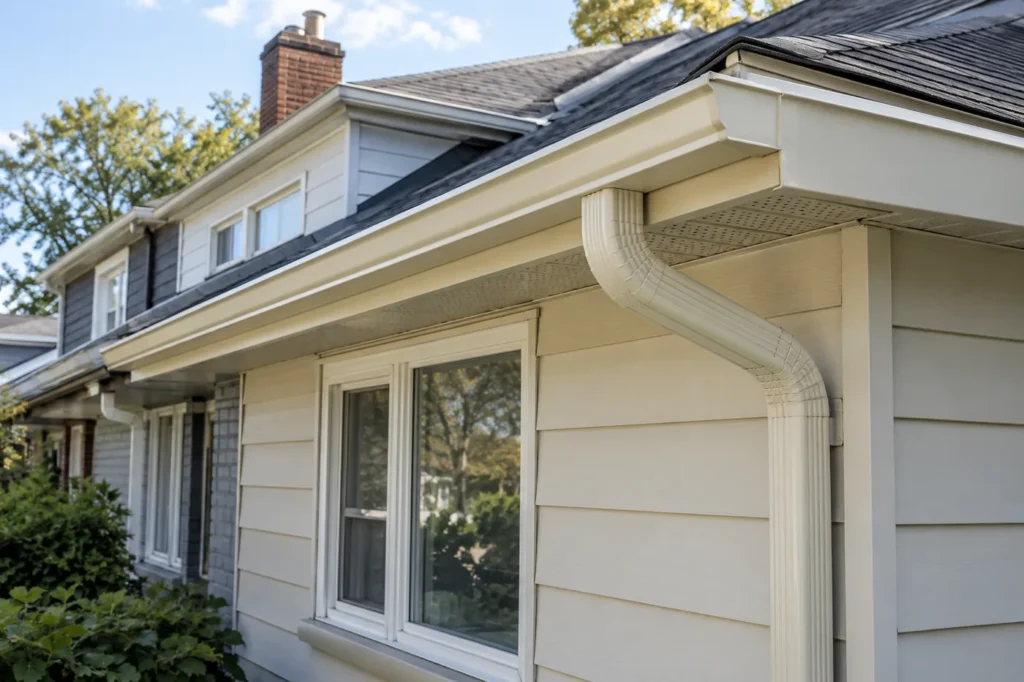

How the roofline changes a seamless quote
Scope varies with roofline length, corners, profile, colour, access, storeys, fascia condition, existing gutter removal and changes to downspouts. The straight-run advantage becomes less decisive on a highly interrupted roofline, where corners and outlets dominate the details. These factors also influence installation time and price.
Details to include in your request
Send broad photos of each roofline and close views of corners, end caps and old outlet locations. Identify where the existing gutter overflows or retains water, and photograph the current downspout discharge area. Note whether you want the colour to match existing soffit or fascia.
Continue planning the right work
A continuous run is one option within the full replacement plan. If the current system overflows, the size guide explains why roof catchment and outlets matter more than a label alone. The new channel still needs outlets and downspouts that move water to a suitable location. Consider guards only after slope, attachment and outlet behaviour are understood, since a cover cannot correct a failed underlying run.